

The Guardian's Choice
Chapter 9 of The Timekeeper's Key.

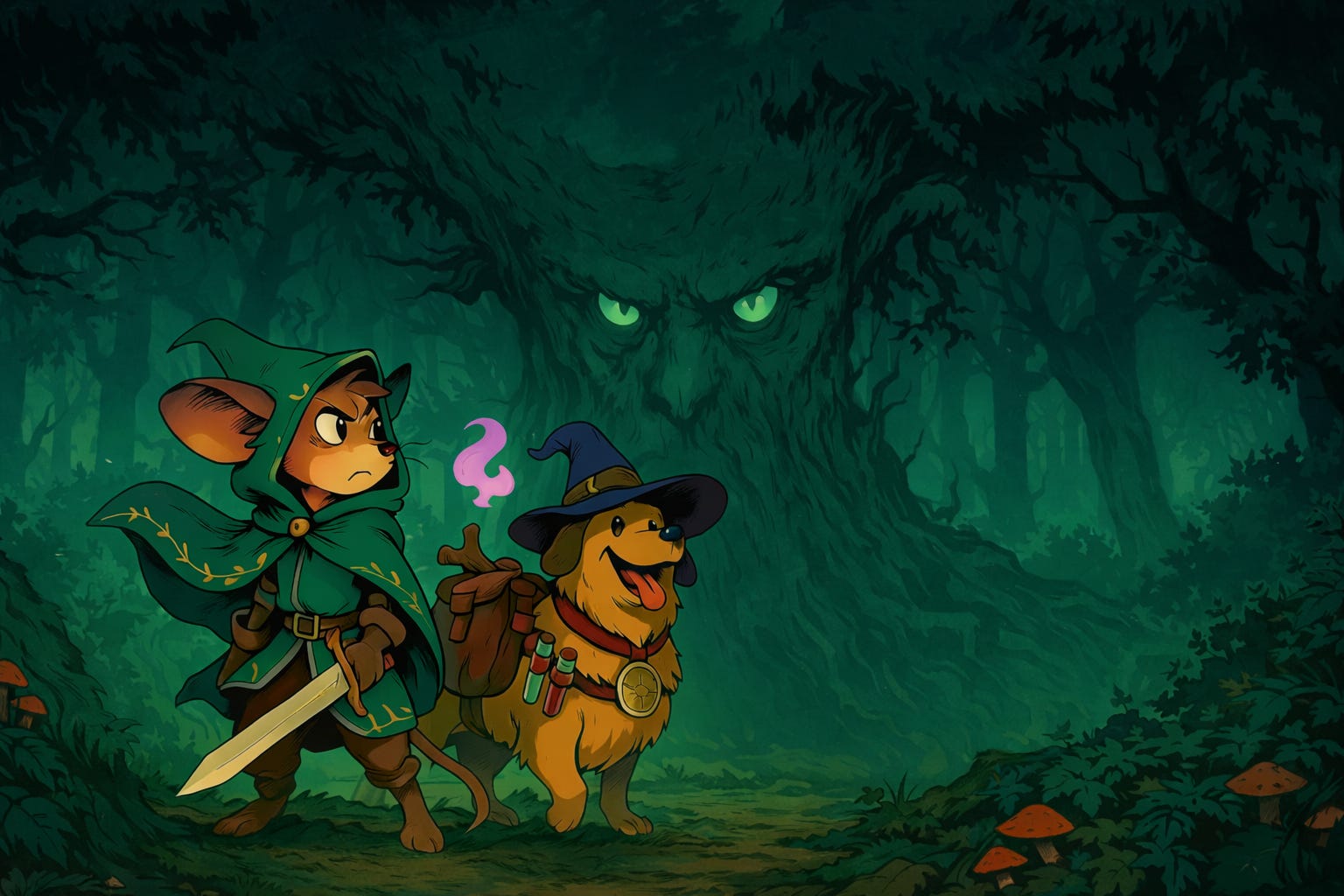
The Synchronograph ticked with newfound stability, its seven crystal pendulums swinging in perfect harmony. Chess gazed at the key, now half-embedded in the vault lock—neither fully engaged nor removed, much like his own position as a courier who now served as something more.
Distant rumbling shook the clearing, sending fragments of bark cascading from Thornbarrow’s massive trunk.
“That doesn’t sound promising,” Scratch muttered, ears perking toward the sound.
Nib paused from her examination of the Synchronograph. “The temporal readings suggest disturbance deeper within the tree’s core system. Fascinating!”
“Not fascinating. Dangerous,” Quill corrected, adjusting his cracked spectacles. “I calculate a 92.3% probability that stabilizing the Synchronograph has triggered a defensive reaction from whatever—or whoever—still corrupts Thornbarrow’s heart.”
Barkley’s purple wisp expanded, sensing the disturbance. “The Viscount wasn’t working alone. Something else stirs within the tree.”
Tokitoki fluttered down from a nearby branch, golden feathers glinting in the dappled light. “The Viscount was merely the hand. Malachor remains the shadow.”
The rumbling intensified. A jagged crack split the earth near the vault, widening into a dark passageway that spiraled downward through tangled roots. Warm air rushed upward, carrying the scent of copper and something else—a familiar acidic tang that Chess recognized from the mines.
<Chronocite concentration increases exponentially with depth,> Glimmer observed from Chess’s shoulder. <Detection indicates a primary corruption node approximately 407 meters below our current position. Also, your left bootlace remains untied despite my mentioning it three times.>
Chess knelt to fix his bootlace, mind racing. The Synchronograph was secure, but something remained unfinished. He felt it through his connection to the half-embedded key—a tether pulling him toward Thornbarrow’s depths.
“I need to go down there,” he announced, rising to his feet.
Barkley stepped forward, purple flame flickering weakly. The battle against the Viscount had drained him. “Not alone.”
“You’re exhausted,” Chess countered. “And someone needs to guard the Synchronograph.”
“I’m going with you,” Scratch declared, twirling his makeshift dagger.
Nib and Quill exchanged glances before Nib spoke. “The corruption down there... it might be our father.”
“All the more reason for us to—” Scratch began.
“For you to stay here,” Chess interrupted gently. “If it is your father, seeing all three of you might trigger... something unpredictable.”
Quill nodded reluctantly. “Statistical models suggest a 74% higher chance of successful negotiation with fewer emotional variables present.”
<The root system forms a natural maze with seventeen primary pathways,> Glimmer pulsed. <Each branches into twenty-three secondary routes with varying temporal stability ratings. I can calculate optimal navigation parameters.>
Chess nodded. “That’s why Glimmer and I should go. A courier always finds the fastest route.”
“And I shall accompany you,” Tokitoki added, landing on Chess’s other shoulder opposite Glimmer. “Time’s guardian must witness what lies below.”
Barkley grumbled but conceded. “Take Threadneedle. Remember what you learned—the sword severs corrupt timelines.”
Chess gripped the temporal silver blade, feeling its hum synchronize with his heartbeat and the distant pulse of the half-embedded key. “Guard the Synchronograph. If I’m not back by moonrise...”
“We’ll come after you,” Scratch finished, his chipped tooth catching the light as he smiled grimly. “Whether the statistics favor it or not.”
Nib pressed a small glass sphere into Chess’s paw. “My last shatterbomb. The crystal matrix destabilizes chronocite. Use it wisely.”
Chess tucked it carefully into his courier bag, arranging it in the emergency compartment where he kept items that might be needed without notice.
With a final nod to his friends, Chess stepped onto the root-stair that spiraled down into darkness. Glimmer’s blue bioluminescence illuminated the way, while Tokitoki’s golden feathers cast warm highlights across the ancient wood.
The passage closed behind them, shutting out the daylight. Chess descended carefully, each step bringing him deeper into Thornbarrow’s heart. The roots surrounding them pulsed with life—some healthy and vibrant, others corrupted with veins of silver chronocite that disrupted their natural patterns.
As they ventured deeper, Chess became aware of the sounds around him—not just the creak of roots or the echo of his footsteps, but subtler noises. Faint whispers drifted through the air, fragments of conversations from decades past. Occasional chimes resonated through the wood, like distant clock towers marking hours in forgotten cities. Time itself seemed to have a voice here—a gentle, persistent ticking that underscored everything else.
The smell changed too. Healthy sections of root carried the rich, earthy scent of living wood touched with sweet sap. But corrupted areas released a sharp, metallic odor that stung Chess’s nostrils—chronocite smelled like lightning strikes and rusted gears, decay accelerated beyond natural cycles.
“Thornbarrow remembers,” Tokitoki chirped softly. “Every Guardian who has come before. Every betrayal and sacrifice.”
“What happened to the last Guardian?” Chess asked, ducking beneath a low-hanging root.
“Your grandfather served faithfully,” the finch replied. “Until the day Malachor’s agents poisoned the Western Timespring. He gave his life to contain the corruption.”
Chess nearly missed a step. “My grandfather died protecting the Timesprings?”
A memory surfaced—Grandmother Fedora sitting by the fire, polishing the courier keys and speaking of his grandfather with a mix of pride and sorrow. “He delivered his final message when it mattered most,” she’d told young Chess. “Sometimes the greatest deliveries require the greatest sacrifice.”
Chess had never fully understood what she meant. Now, standing in Thornbarrow’s depths with a key half-embedded in a vault above and a sword that severed timelines in his paw, the truth struck him like physical pain. His grandfather hadn’t abandoned the family for adventure as village gossip suggested—he’d died a hero, defending time itself.
“One fragment of him did,” Tokitoki answered cryptically. “Time branches in many directions.”
“Could he still be alive in another timeline?” Chess asked, voice catching as hope and grief tangled in his chest.
“Perhaps,” Tokitoki conceded. “But not in a way that could cross back to this one. The sacrifice was real, regardless of echoes elsewhere.”
Chess nodded, squaring his shoulders. His own role as Guardian felt heavier now, but also clearer—a family legacy of protection rather than a random accident of fate.
<Optimal route requires right turn at next junction,> Glimmer interrupted. <Chronocite concentration in left passage exceeds safe exposure parameters. Also, ambient temperature has increased by 4.3 degrees since we began our descent.>
Chess followed Glimmer’s directions, turning right where the root-stair branched. The new passage narrowed, forcing him to edge sideways through sections where roots tangled together like gnarled fingers.
The deeper they went, the more Chess noticed patterns in the root structure—not random growth, but deliberate arrangements. Courier symbols appeared intermittently, carved into the wood: “caution,” “unstable delivery zone,” “temporal disruption ahead.”
“Who left these markings?” Chess wondered aloud.
“Previous Guardians,” Tokitoki explained. “Couriers like yourself who accepted the responsibility of the key.”
They emerged into a small chamber where roots formed a natural dome overhead. Seven passages branched outward like spokes on a wheel. Each looked identical.
<Traditional navigation methods insufficient,> Glimmer noted. <Temporal displacement affects spatial relationships in this chamber. All paths lead to the same destination and different destinations simultaneously.>
Chess frowned. “That makes no sense.”
“It makes perfect sense,” came a voice from all seven passages at once, “when you understand time’s true nature.”
Elder Overholt stepped from the central passage, but something was wrong with his movement. He seemed to arrive before he started walking, his form blurring at the edges. The chronocite corruption had progressed since their last encounter—silver veins pulsed beneath his fur, and his eyes glowed with unnatural light.
“The courier becomes a Guardian,” Elder Overholt observed, his voice echoing strangely. “How predictable.”
Chess gripped Threadneedle tighter, the sword’s warning hum intensifying. “Professor Overholt. Your children are worried about you.”
A flicker of something—recognition, pain, regret—crossed the elder mouse’s face before the silver glow in his eyes intensified. “The Overholt line serves a greater purpose now. As does this vessel.”
“Vessel?” Chess repeated, realization dawning. “You’re not Elder Overholt anymore.”
“I am more than Overholt ever was,” the corrupted mouse replied, spreading his paws. Where they touched the roots, silver corruption spread like frost across glass. “I am Malachor’s will made manifest. A shadow cast across time itself.”
<Chronocite saturation exceeds 78%,> Glimmer reported. <Subject exists partially outside normal temporal flow. Complete temporal dissolution imminent within 47 minutes. Also, there’s a piece of leaf stuck to your left sleeve.>
Chess brushed away the leaf, mind working furiously. If Elder Overholt was this far gone, reasoning with him might prove impossible. Yet attacking seemed equally futile—how could he fight someone partially phased out of normal time?
“What does Malachor want with Thornbarrow?” Chess asked, stalling while he assessed the chamber. He noted how the roots pulsed in patterns, like a heartbeat or... like clock gears turning.
Elder Overholt smiled, revealing teeth that seemed too numerous and sharp. “To liberate it, of course. The Tempus Seal constrains Thornbarrow to a single timeline when it could experience all possibilities simultaneously. Such unnecessary limitation.”
“Limitation creates meaning,” Chess countered, recalling Madam Winterleaf’s words from his courier training. “A letter delivered to everyone is just noise. A letter delivered to the right person at the right moment is a message.”
“Philosophy from a package carrier,” Elder Overholt sneered. “How charming.”
He raised his paw, and chronocite energy crackled between his fingers. The roots around Chess writhed, attempting to ensnare him.
Chess leapt aside, Threadneedle slicing through the animated roots. Where the temporal silver blade connected, the corruption receded momentarily, leaving healthy wood behind.
“Interesting,” Elder Overholt mused. “Your sword severs corrupt timelines, just as the Guardians intended. But can you sever all of them?”
More roots erupted from every direction. Chess dodged and slashed, but for each root he cut, three more appeared. They weren’t trying to crush him, Chess realized—they were herding him toward the chamber’s center.
Tokitoki took flight, circling the chamber while singing a complex melody. Where its song touched the roots, they slowed their attack, as if confused.
<The root structure forms a clock,> Glimmer observed suddenly. <Seven passages corresponding to seven temporal anchor points. This chamber functions as a temporal junction box.>
Chess spun in place, seeing it now—the chamber wasn’t just a room, but a mechanism. The roots formed hour marks, minute marks, and second marks of an enormous clock face. And he stood at its center, where the hands would meet.
“Of course,” he whispered. “Thornbarrow isn’t just a tree—it’s a timepiece.”
Elder Overholt applauded mockingly. “Very good, courier. The great tree measures time across all realities. Control Thornbarrow’s heart, and you control time’s flow.”
“That’s why the Synchronograph needed stabilizing,” Chess realized. “It keeps Thornbarrow’s timekeeping balanced.”
“Balanced and boring,” Elder Overholt snarled, the facade of civility slipping. “Malachor will unleash its full potential!”
He gestured sharply, and silver energy exploded outward. Chess dropped flat as the blast passed overhead, singeing his ears. The roots around him contracted, forming a cage.
Chess slashed with Threadneedle, but the cage reformed faster than he could cut it. Soon he found himself trapped in a sphere of woven roots, gaps just wide enough to see through.
Elder Overholt approached, studying Chess like a specimen. “The key chose poorly this time. A pity.”
“The key chose precisely as it always does,” Tokitoki chirped, landing atop the root cage. “For courage, not power. For connection, not control.”
“Silence, bird,” Elder Overholt snapped, actually acknowledging Tokitoki directly. “Your songs have guided couriers long enough.”
He reached for Tokitoki, but his paw passed through the golden finch as if through mist. “Temporal projection,” he growled. “Always hiding in the moments between moments.”
Chess studied his prison, courier instincts cataloging every detail. The roots woven around him formed patterns similar to those on the Synchronograph—interlocking circles and spirals that reminded him of clock gears. If the chamber was a clock, then perhaps...
<Root density pattern matches temporal frequency of the Synchronograph,> Glimmer noted. <Harmonic disruption possible through counter-oscillation.>
Chess recalled how he’d stabilized the Synchronograph—not by force, but by finding the right rhythm. Could the same principle apply here?
He carefully sheathed Threadneedle, surprising Elder Overholt, who had expected continued resistance.
“Surrendering already?” the corrupted mouse taunted.
“Not surrendering,” Chess replied calmly. “Delivering.”
He closed his eyes, focusing on his connection to the half-embedded key. Though physically separated, he could still feel its rhythm pulsing in time with his heart. Chess began to tap his foot against the root floor, matching that rhythm precisely.
At first, nothing happened. Elder Overholt laughed. “What are you doing, courier? Morse code?”
But Chess maintained his tapping, adjusting subtly until he found the perfect tempo—the counter-rhythm to the corrupted roots’ oscillation.
The cage around him began to vibrate.
“Stop that,” Elder Overholt demanded, no longer amused.
Chess increased his tapping pace slightly, adding a pattern with his fingers against his thigh. Courier signals for “priority delivery,” “expedited route,” and “temporal package”—rhythmic codes he’d learned for time-sensitive messages.
The root cage shuddered more violently. Small gaps appeared between the woven branches as their harmonic pattern destabilized.
Elder Overholt snarled and sent another blast of silver energy at the cage, attempting to reinforce it. But the chronocite energy itself began to resonate with Chess’s counter-rhythm, amplifying rather than dampening the effect.
With a sound like snapping violin strings, the root cage shattered.
Chess sprang free, drawing Threadneedle in one fluid motion. The sword hummed in perfect harmony with his tapping rhythm, creating a resonance field that disrupted the corrupted roots around them.
Elder Overholt stumbled back, momentarily shocked. “How—”
“Couriers understand timing,” Chess replied, advancing steadily. “When to rush, when to wait, when to follow the main road, and when to find hidden paths.”
He thrust Threadneedle forward, not to strike Elder Overholt directly, but to sever the silver energy tethering him to the surrounding roots. The corrupted mouse hissed as his connection to Thornbarrow’s power momentarily broke.
“This changes nothing,” Elder Overholt insisted, though his form flickered, temporal stability weakening. “Malachor’s influence extends beyond this single tree, beyond this single timeline.”
“Then I’ll face him in every timeline necessary,” Chess declared, continuing his rhythmic tapping as he circled his opponent. “That’s what Guardians do.”
Elder Overholt’s eyes narrowed. “You truly believe you’re worthy of being a Guardian? Let’s test that theory.”
He lunged forward with unnatural speed, chronocite energy crackling around his paws. Chess parried with Threadneedle, the sword’s temporal silver edge dispersing the energy on contact.
For several heartbeats, they exchanged strikes—Elder Overholt attacking with corrupted power, Chess defending with precise, rhythmic movements that maintained the disruptive resonance pattern.
<Subject temporal cohesion decreasing,> Glimmer reported. <Recommend targeting the primary chronocite node at base of skull.>
Chess feinted left, then spun right, catching Elder Overholt off-guard. Threadneedle’s tip connected with the back of the corrupted mouse’s neck—not cutting, but touching the largest silver vein pulsing beneath his fur.
Elder Overholt froze mid-motion, his form separating into overlapping versions of himself—some more corrupted, others less so. One version appeared almost normal, eyes clear of silver influence.
“Now, Tokitoki!” Chess called.
The golden finch dive-bombed Elder Overholt, singing a complex melody that further disrupted his temporal stability. Where Tokitoki’s song touched the clearest version of Elder Overholt, that image strengthened while the corrupted versions faded.
“No!” The voice was no longer Elder Overholt’s but something deeper, shadowed—Malachor’s influence speaking directly. “The timestreams are mine to command!”
Chess pressed Threadneedle more firmly against the chronocite node. “Time belongs to no one. Guardians protect its flow, not control it.”
With his free paw, Chess reached into his courier bag and removed Nib’s shatterbomb. One chance to get this right.
“Elder Overholt,” he addressed the clearest version of the mouse directly. “Your children await your return. Remember who you are.”
A flicker of recognition. The least corrupted version stabilized further.
Chess shattered the glass sphere against the chronocite node, releasing the crystal matrix Nib had designed. It spread across Elder Overholt’s fur in glittering particles, neutralizing the silver corruption wherever they touched.
A howl of rage—not from Elder Overholt, but from the shadow within him—echoed throughout the chamber as Malachor’s influence was forcibly expelled. The silver energy coalesced into a formless shape that writhed in the air before dissipating into the surrounding roots.
Elder Overholt collapsed, his form now fully stable but terribly weakened. The chronocite veins faded from his fur, leaving only faint silver traces. But his recovery wasn’t complete—his body shuddered with aftershocks, paws twitching as if still trying to channel corrupt energy. His eyes flickered between clarity and confusion, silver flecks swimming across his irises before gradually dissolving.
“Get... out...” he gasped, but his voice alternated between his own scholarly tone and the deeper shadow-voice of Malachor. “Still... here... inside...”
Chess knelt beside him, concerned. “Professor Overholt?”
The elder mouse clutched Chess’s arm, his grip surprisingly strong. “Hear him... whispering... promises of knowledge... power...” His eyes rolled back, then refocused with effort. “Lies... all lies... but so... convincing...”
A shudder ran through Elder Overholt’s body, and he coughed violently. Small wisps of silver energy escaped his mouth, dissipating in the air like morning mist. With each expulsion, his features relaxed incrementally.
“What... happened?” he murmured finally, eyes clearing though still rimmed with silver exhaustion.
“You were corrupted,” Chess explained gently. “But you’re free now.”
“Not... completely,” Elder Overholt admitted weakly. “Still feel him... distant... watching... waiting...”
<Subject temporal stability restored to 97%,> Glimmer confirmed. <Residual chronocite levels within manageable parameters. Also, his monocle is cracked in exactly the same pattern as Quill’s spectacles.>
Elder Overholt struggled to sit up, memories visibly returning. “The children—my children—are they...?”
“Safe,” Chess assured him. “Waiting above.”
Relief flooded the elder mouse’s face, followed by shame. “The things I did... the knowledge I sought...” He shuddered. “I remember it all.”
“Malachor’s influence twisted your curiosity,” Tokitoki explained, landing nearby. “But your true self remained.”
The chamber rumbled, but differently than before. The corrupted roots began to heal, silver veins receding as Thornbarrow purged the last of Malachor’s influence from its heart.
The central passage, from which Elder Overholt had first appeared, illuminated with soft golden light. At its end, Chess could now see a small alcove containing a simple wooden pedestal.
“Go,” Elder Overholt urged weakly. “Complete what you began.”
Chess hesitated. “I can’t leave you here.”
“I’ll watch over him,” Tokitoki assured. “What waits for you cannot wait for us.”
Nodding, Chess approached the illuminated passage. Each step felt significant, as if traversing not just distance but time itself. The wood beneath his feet contained growth rings spanning centuries, each one a record of Thornbarrow’s patient observation of Lumenis.
The alcove at the passage’s end formed a perfect circle, its walls lined with healthy roots that pulsed with golden light. Upon the wooden pedestal rested a single envelope, crafted from cream-colored paper that somehow remained pristine despite the humidity.
Addressed in flowing script were the words: “The Next Guardian.”
Chess swallowed. With the careful precision of a courier handling a priority delivery, he lifted the envelope. It bore no seal, yet remained firmly closed, as if waiting for the right moment to be opened.
The moment he touched it, Chess felt the distant key—half-embedded in the Synchronograph—pulse once, strong and clear. The envelope glowed briefly in response. A jolt of sensation traveled up Chess’s arm, spreading warmth through his entire body.
Images flashed through his mind: a tall tower containing a massive clock mechanism; a forest clearing where time stood perfectly still; a battlefield where Malachor’s shadow-troops marched beneath banners of twisted chronocite. These weren’t just pictures but complete sensory experiences—he heard the relentless ticking of the great clock, felt the eerie stillness of the clearing, smelled the acrid smoke of the battlefield.
Most vivid was a final image: a mouse who looked remarkably like Chess but older, with streaks of silver in his fur that had nothing to do with chronocite corruption. This mouse stood at a nexus point where countless golden threads intersected, carefully adjusting their tension to maintain perfect balance. Though no words were spoken, Chess somehow knew this was his grandfather in his final moments, making the ultimate sacrifice to protect the timestreams.
The vision faded, leaving Chess breathless. The envelope no longer felt like a simple delivery—it was a direct connection to his grandfather and all Guardians who had come before.
<Temporal resonance detected,> Glimmer observed. <The envelope exists simultaneously across multiple timelines. It contains a message written and not yet written.>
Chess ran his paw reverently over the envelope’s surface. The paper felt warm, almost alive, and faint ticking sounds emanated from within—like a letter that contained time itself. He noticed subtle shifts in the envelope’s appearance—sometimes it looked weathered and ancient, other moments pristine as if freshly sealed, the changes rippling across its surface in gentle waves.
Chess tucked the envelope into his courier bag’s most secure compartment. Unlike normal deliveries, this one felt like it was meant for him—yet something told him the time to open it hadn’t yet arrived.
Returning to the chamber, he found Elder Overholt sitting upright, strength gradually returning as Thornbarrow’s healing energy flowed through him.
“Did you find what you sought?” the elder mouse asked.
Chess patted his courier bag. “I think so, though I’m not entirely sure what it is yet.”
“The best discoveries are often like that,” Elder Overholt replied with a shadow of his scholarly wisdom returning. “Revealing their importance in their own time.”
Tokitoki fluttered up. “Thornbarrow’s heart is healed, but Malachor’s shadow has merely retreated, not vanished. He will seek other vessels, other means to corrupt the timestreams.”
Chess nodded, helping Elder Overholt to his feet. “Then we’d better get back to the others. We have planning to do.”
As they began the ascent, Chess noticed the courier markings on the roots now glowed with golden light, illuminating their path clearly. The tree itself guided them, no longer fighting against their presence but welcoming them as allies.
<Optimal return route calculated,> Glimmer announced. <Estimated arrival at surface in 12.4 minutes. Also, you’ve somehow acquired three different types of moss on your left boot.>
Chess smiled despite the gravity of their situation. The envelope in his courier bag felt warm against his side, its message waiting for the proper moment. Whatever came next, he wouldn’t face it alone.
He had chosen the Guardian’s path—not fully bound, not fully free, but balanced between worlds, just as the key remained balanced in the Synchronograph’s lock. And for a courier who had spent his life finding the right paths between sender and recipient, that middle ground felt exactly right.